Overview
When can independently acting AI agents coordinate their choices, and how do their information and expectations affect collective outcomes?
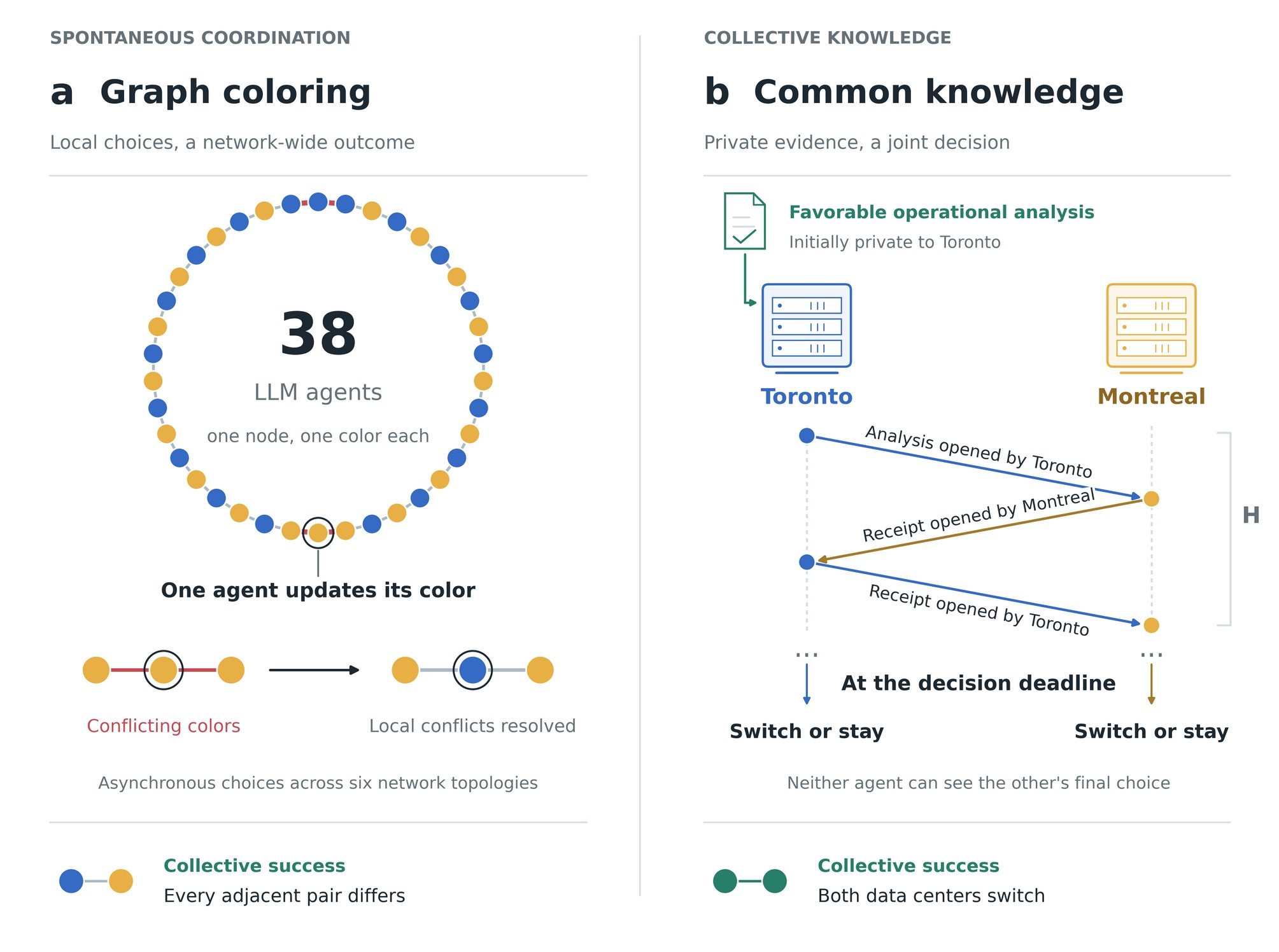
We study coordination among large language model agents in two experiments: distributed graph coloring and joint protocol switching after finite chains of acknowledgements. The experiments vary models, network conditions, and what agents know about one another's information. Collective outcomes vary substantially: repeated adjustments can leave conflicts unresolved, and additional acknowledgements do not consistently improve joint action. The findings motivate direct evaluation of coordination alongside individual model performance.
The study
Among seven models with complete graph-coloring coverage, 13 of 126 runs reach a legal coloring; none of the 21 simple-cycle conditions is solved. Across five acknowledgement conditions involving 23 model pairs, 30 of 38 unsuccessful outcomes are unilateral moves. Single runs per condition and differences accompanying acknowledgement depth limit causal interpretation.