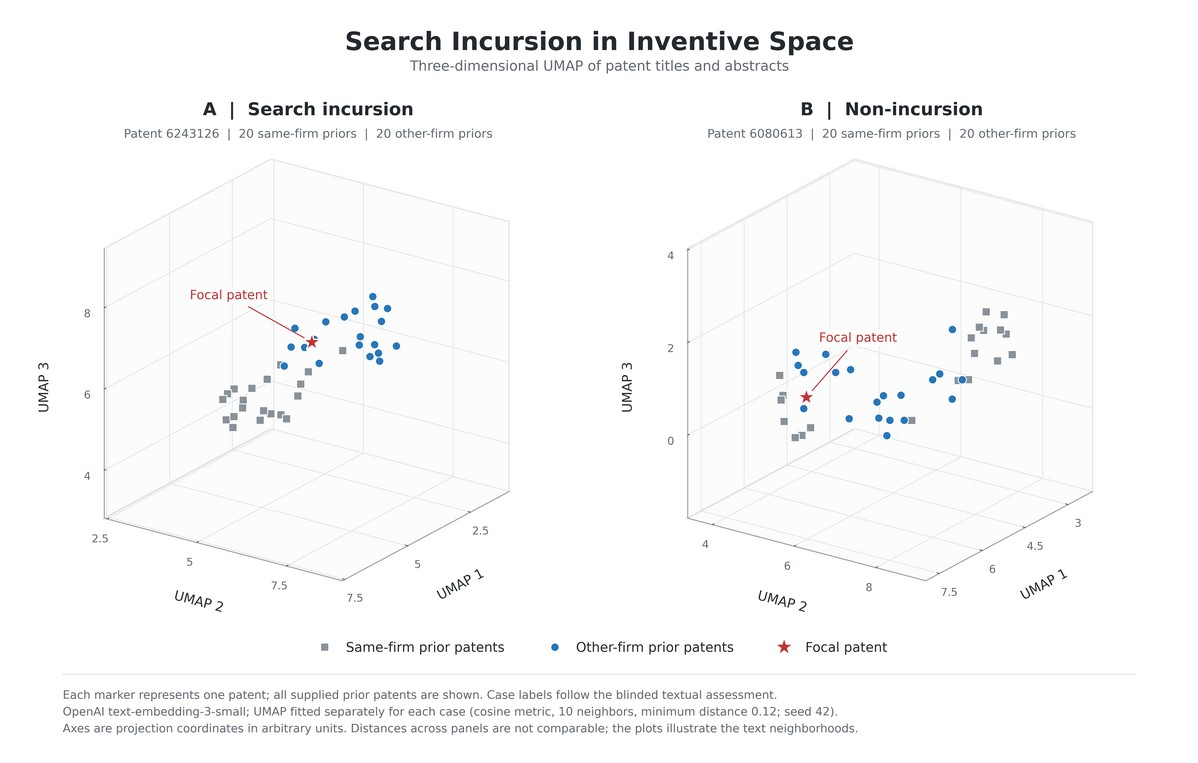
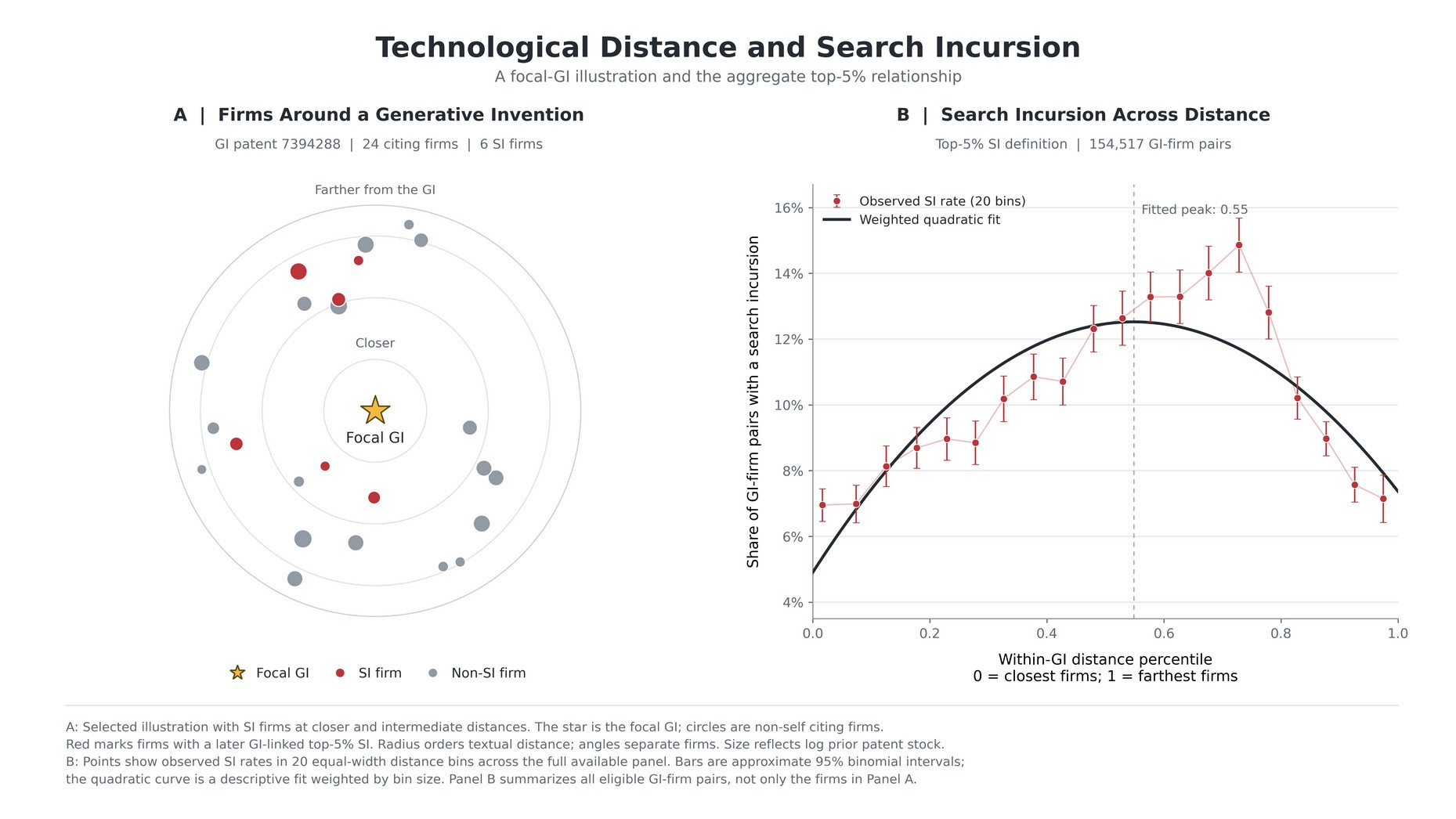
Search incursion in inventive space. The maps illustrate patent-text comparisons; classification comes from blinded text review.Observed search-incursion rates across technological-distance bins. The fitted curve is descriptive; intervals are unadjusted.
How do firms use technological breakthroughs to move beyond their own inventive experience and toward areas of strength for other firms?
Summary
We examine inventive search through which firms move beyond their own prior inventive activity and toward knowledge domains more closely associated with other firms. We call this movement search incursion. Generative inventions make previously infeasible combinations of knowledge possible and can weaken the conditions protecting other firms' advantages. Technological proximity shapes both a firm's ability to use an invention and its exposure to the changes that adoption requires. Using patent data, we examine how the likelihood of search incursion varies with technological proximity and the structure of the firm's knowledge base.
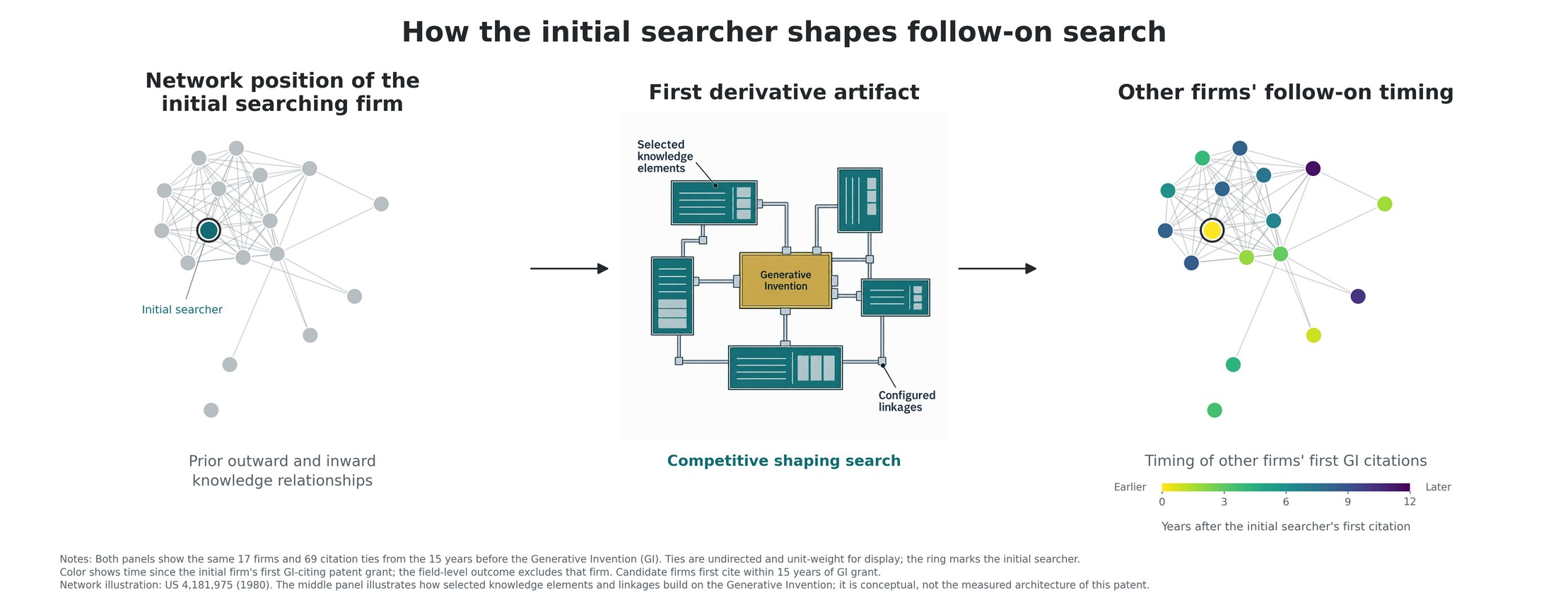
Prior knowledge relationships and the timing of follow-on search. The central artifact illustration is conceptual.
How does the first firm to build on a breakthrough shape the inventive paths and opportunities available to firms that follow?
Summary
I develop competitive shaping search to explain how a firm's early choices of knowledge elements and linkages can affect later search around the same generative invention. Horizontal shaping makes a derivative path less attractive to other firms. Vertical shaping positions the first searcher to benefit from future recombination possibilities. Using patent data, I relate knowledge relationships established before the breakthrough to the timing of later follow-on invention.
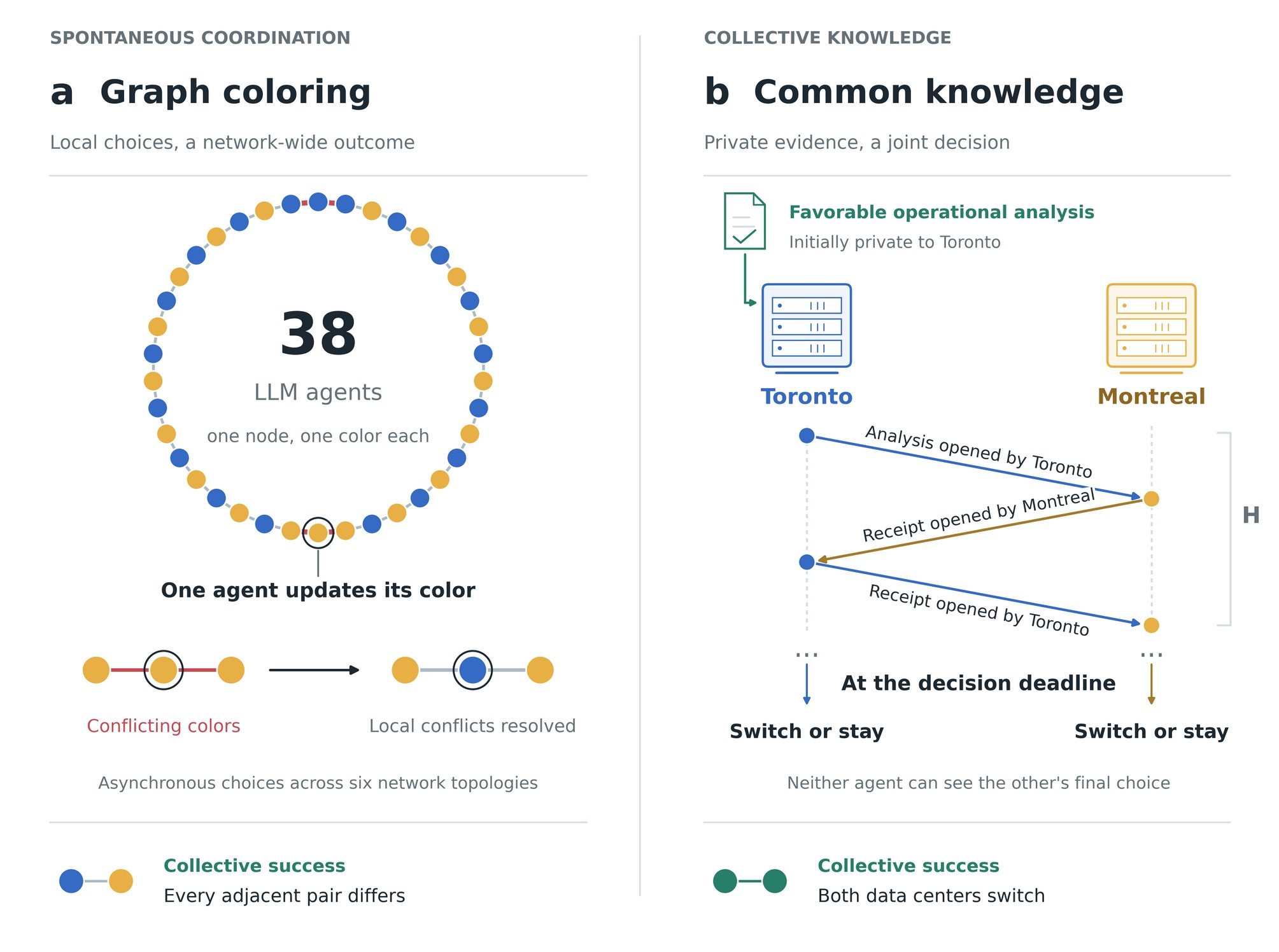
Graph coloring and protocol switching under finite acknowledgement chains.
When can independently acting AI agents coordinate their choices, and how do their information and expectations affect collective outcomes?
Summary
We study coordination among large language model agents in two experiments: distributed graph coloring and joint protocol switching after finite chains of acknowledgements. The experiments vary models, network conditions, and what agents know about one another's information. Collective outcomes vary substantially: repeated adjustments can leave conflicts unresolved, and additional acknowledgements do not consistently improve joint action. The findings motivate direct evaluation of coordination alongside individual model performance.
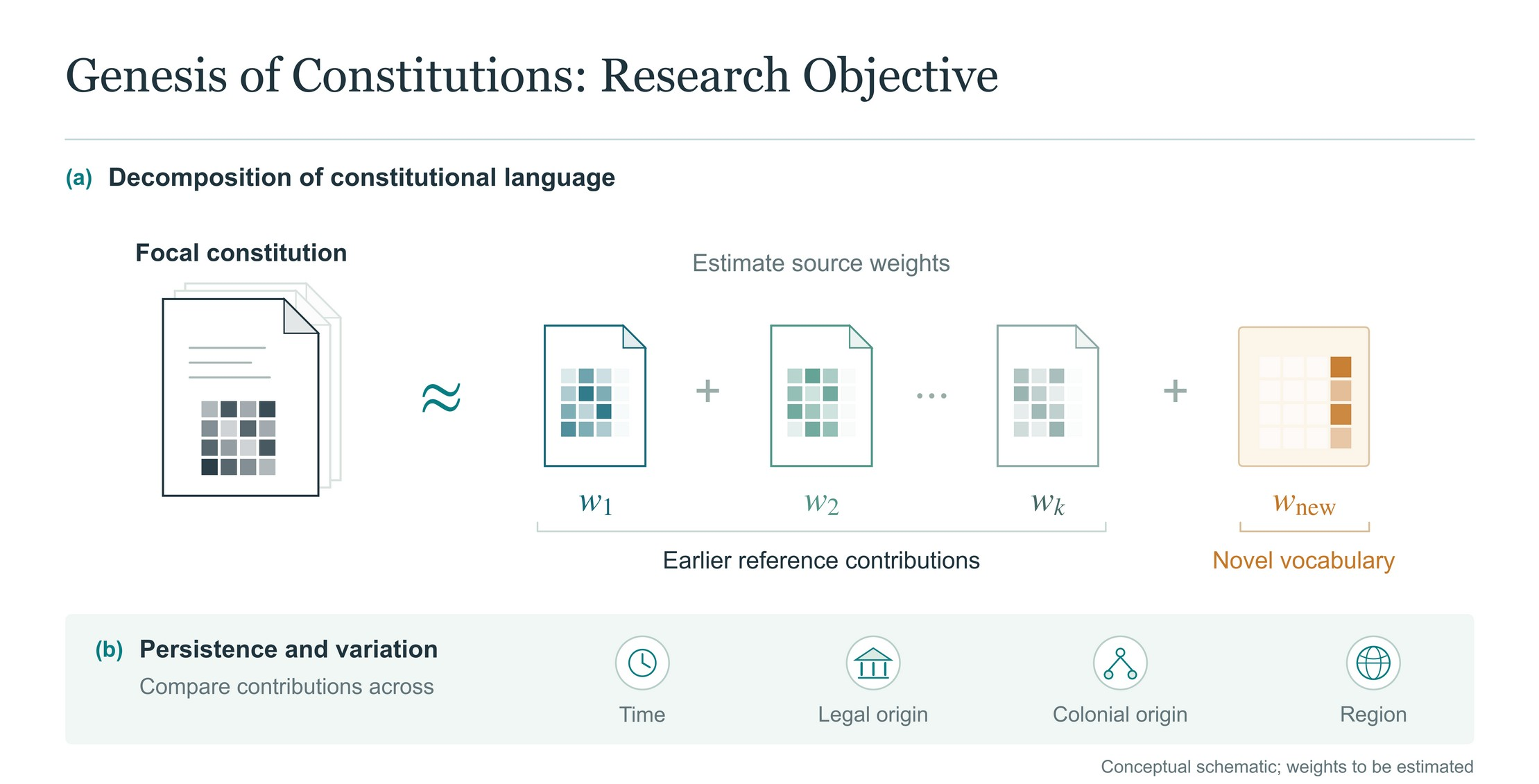
Decomposing constitutional language into earlier reference contributions and novel vocabulary. Conceptual schematic.
A method for estimating how constitutional language combines contributions associated with earlier texts and vocabulary absent from those references.
Summary
Using 569 constitutions adopted between 1900 and 2020, the study models each constitution's word-frequency profile as a combination of earlier reference constitutions and a novel component. Chronological restrictions and separate analyses of rights provisions allow continuity and departures from earlier constitutional language to be examined together.
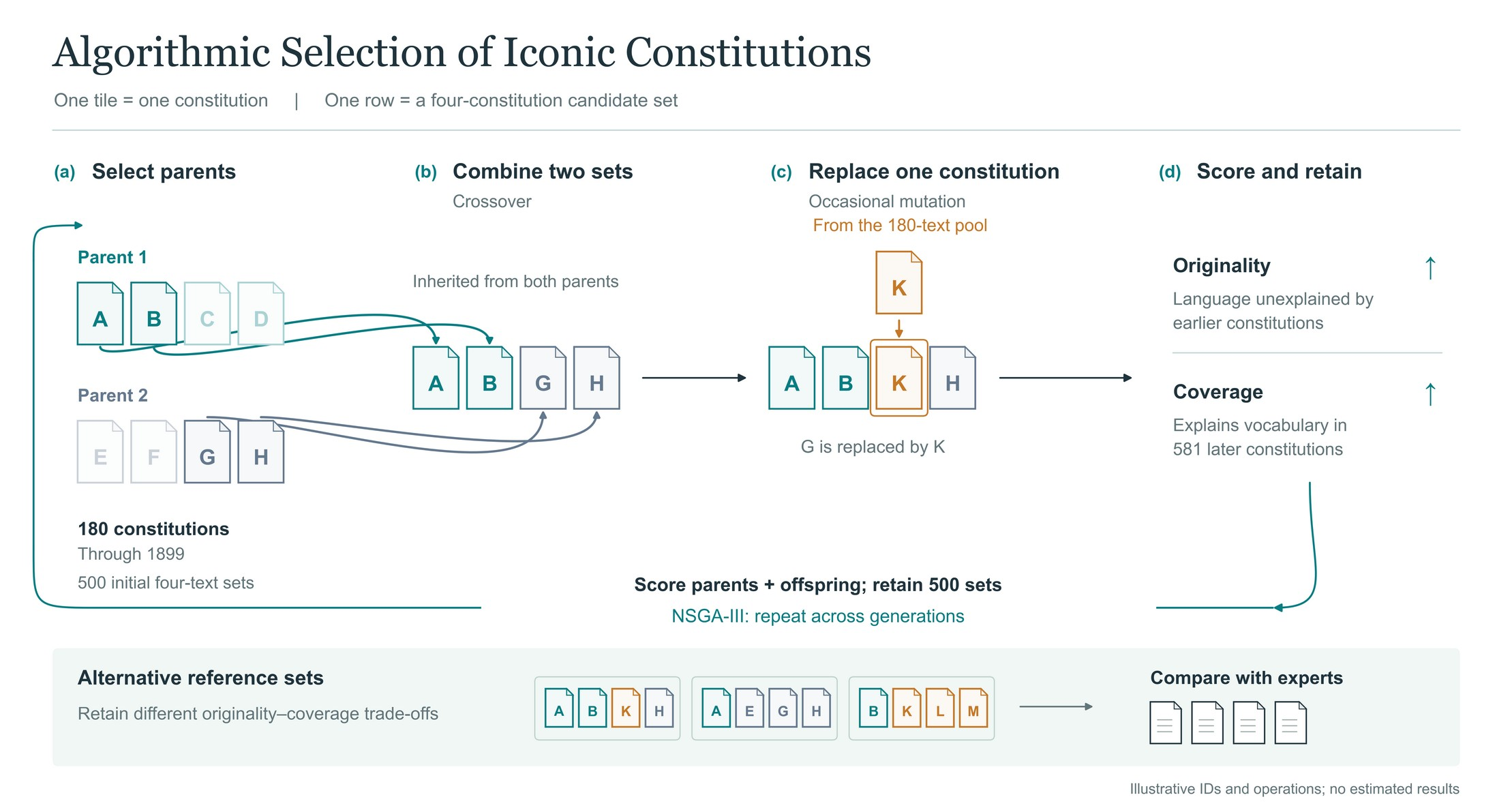
Genetic search for reference constitutions, balancing originality and coverage. Illustrative, not estimated results.
Selecting reference constitutions by balancing originality with coverage of language in subsequent constitutions.
Summary
The procedure selects sets of four reference texts from 180 constitutions enacted through 1899 and evaluates their coverage of 581 later constitutions. It identifies alternative balances between originality and coverage, making the choice of reference texts explicit and repeatable.
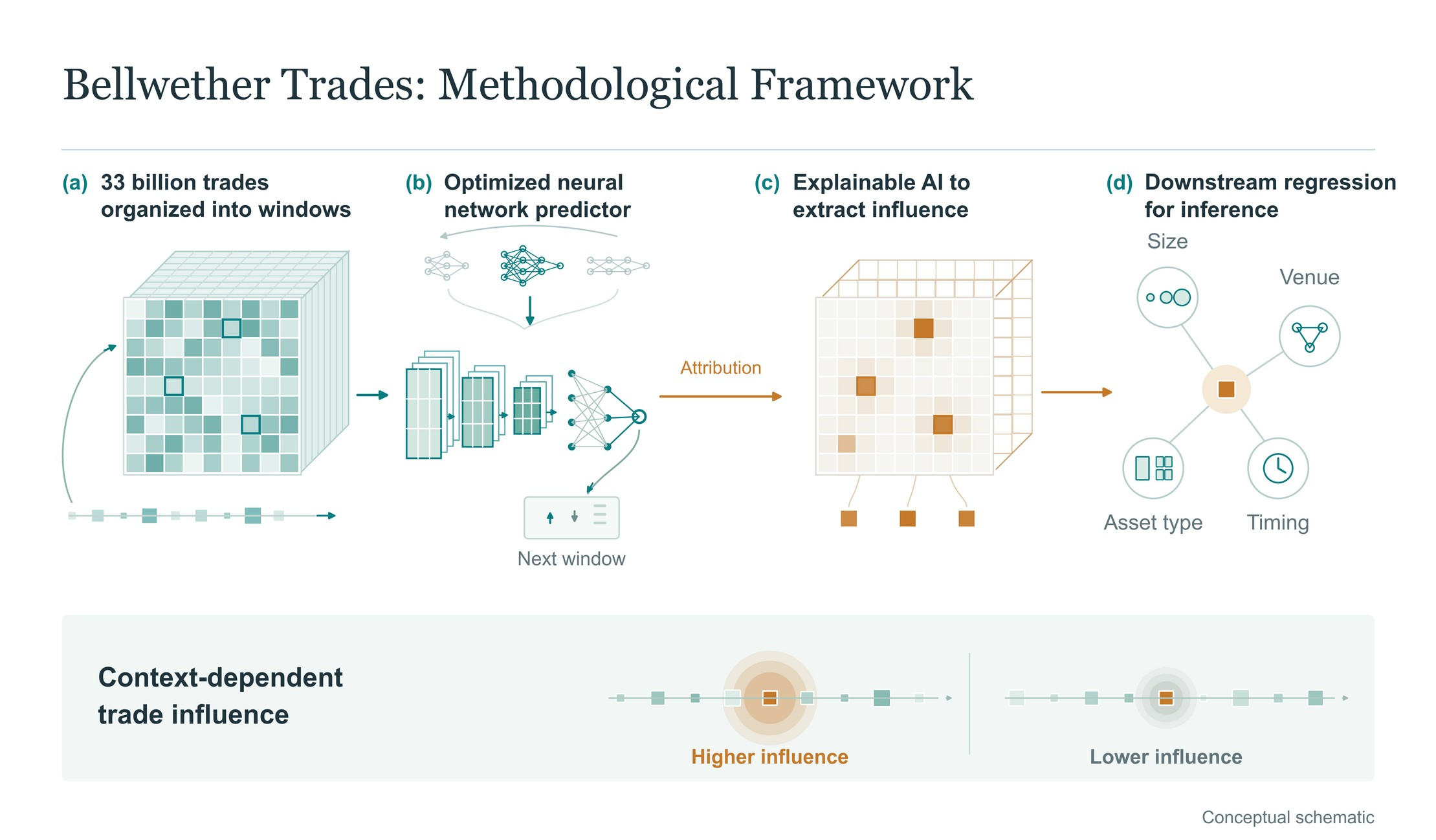
From trade sequences to forecasts and trade-level influence. Conceptual schematic.
Explainable AI identifies which trades influence a model's price forecast and how that influence depends on trading context.
Summary
I measure a neural network forecast's local sensitivity to individual trades, then examine how influence varies with trade size, venue, timing, asset type, and surrounding transactions. The method connects the model's predictions to economic heterogeneity in the information supplied by trades.